The Case for Human-Factors-Grade Agent Interfaces
Agent interfaces need to be measured like decision environments, not judged like landing-page mockups.
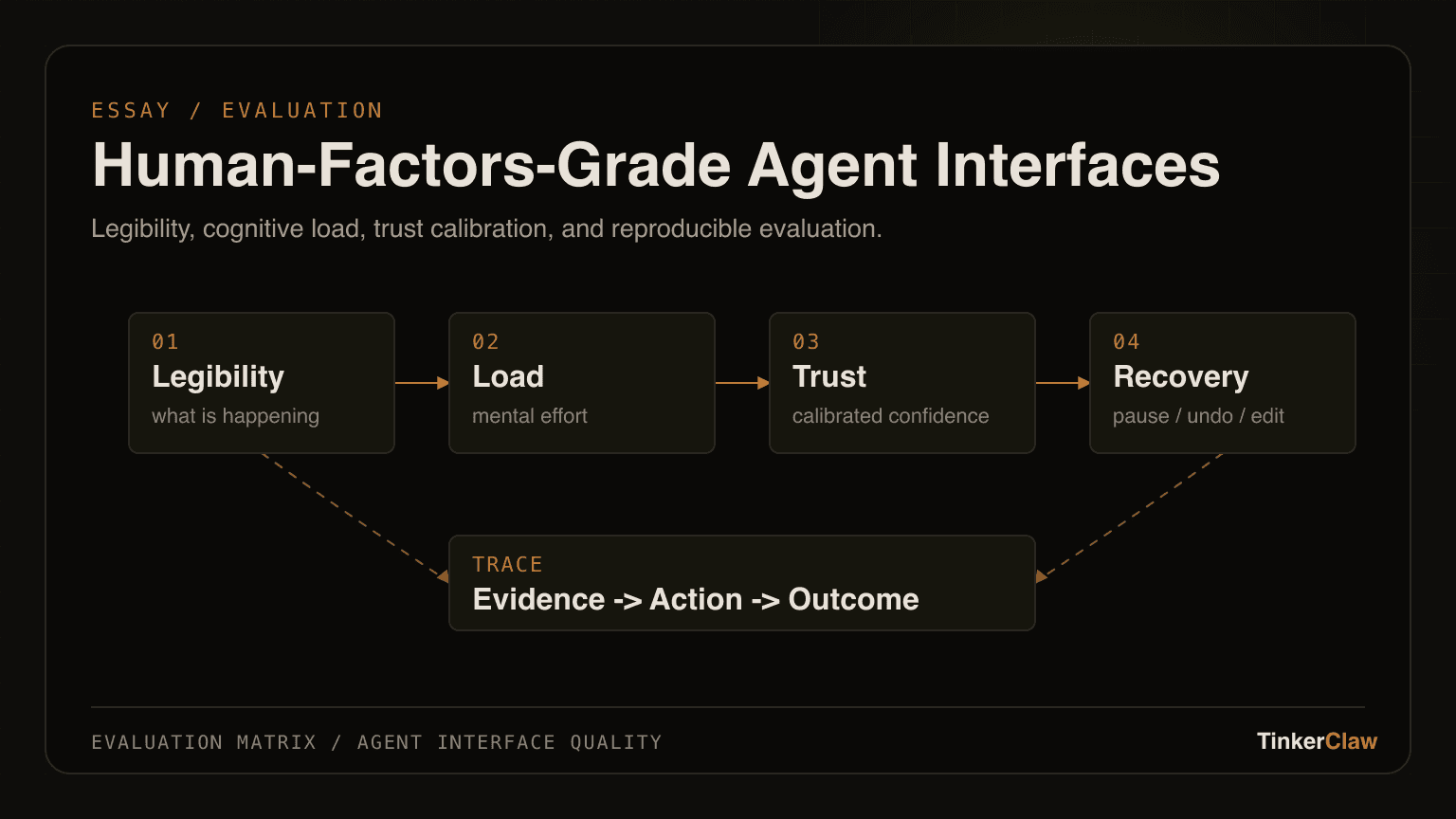
Pretty is not enough
The first wave of agent interfaces tends to be judged by whether they look polished. That is understandable, but it is not sufficient. Agent interfaces are not ordinary content pages. They are control surfaces for systems that can interpret, decide, generate, and act.
A beautiful panel that hides uncertainty is a bad interface. A slick approval flow that makes reversal unclear is a bad interface. A generated dashboard that looks confident while omitting important context is a bad interface. Human-factors-grade design starts from those failure modes.
The real unit is the human-agent loop
When an agent is involved, the interface is only one part of the loop. The user forms intent, the agent interprets it, the system proposes or performs an action, the user supervises, and the outcome feeds back into future trust. Every step can fail.
A human-factors lens asks whether the interface helps the person maintain a useful mental model of what the agent is doing. It also asks whether the person can intervene at the right time without needing to become an expert in the underlying system.
- What does the agent believe the task is?
- What evidence is the agent using?
- What action is about to happen?
- How confident is the system, and why?
- What can the user undo, pause, edit, or reject?
Cognitive load is a product constraint
Agent products often add cognitive load in subtle ways. They ask the user to read generated reasoning, inspect suggested actions, compare alternatives, and decide whether to trust the system. That may be necessary, but it is still work.
The interface should make that work visible and manageable. It should show the right amount of context at the right time. It should collapse details when the user is moving quickly and expose provenance when the stakes are higher.
Trust calibration beats trust theater
A lot of AI UI tries to signal intelligence with animation, confident language, and polished summaries. That is trust theater. Real trust calibration gives the user enough information to know when the agent is likely right, when it is guessing, and when it needs supervision.
This becomes more important as interfaces move beyond chat. In voice interfaces, uncertainty must be audible or quickly inspectable. In XR, an overlay can easily look authoritative because it is spatially attached to the world. In generated dashboards, hierarchy can imply certainty even when the data is weak.
- Show confidence without pretending it is precision.
- Expose evidence and lineage when claims matter.
- Make risky actions visually different from reversible ones.
- Design for interruption, not just confirmation.
A useful evaluation rubric
This work needs repeatable ways to judge whether an agent interface is actually working. The rubric does not need to be academic theater, but it should be more concrete than personal taste.
A first-pass rubric for TinkerClaw should score legibility, interruption cost, cognitive load, reversibility, traceability, latency, and modality fit. Voice, screen-aware UI, generated panels, and XR overlays should all be evaluated against the same underlying questions.
The point is not to make agent interfaces feel more futuristic. It is to make them more inspectable, interruptible, and humane under real use.