Scroll as Investigation #1
What a screen-aware reading app can teach us about ambient, voice-based agent interaction.
The investigation
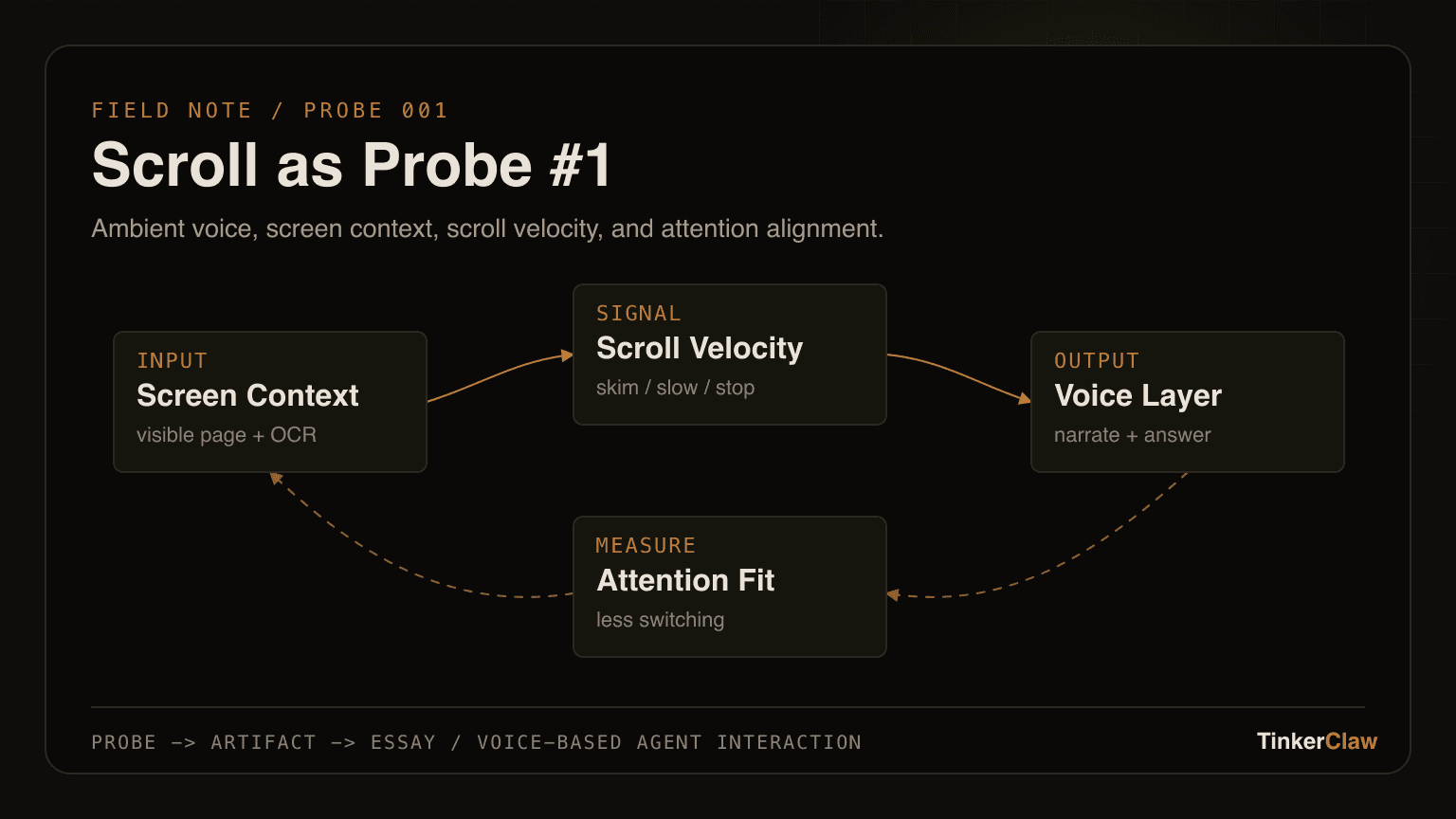
Scroll is the first applied investigation for TinkerClaw because it sits at a useful edge: it is a real product people can use, but it also asks a deeper interface question. If an agent can see what you are reading, sense how quickly you are moving, and speak at the right level of detail, does the interaction stop feeling like a chatbot and start feeling like an ambient layer?
That is the core reason Scroll belongs inside this research track. It is not just a Mac utility. It is a test bed for an agent interface that does not begin with a blank text box. The user is already doing something. The agent has context. The interface should adapt around that activity.
Why reading is a good first environment
Reading is a deceptively rich interface problem. The page has structure, emphasis, scroll position, visual density, and moments where the user is skimming versus slowing down. A chat window ignores most of those signals. Scroll treats them as part of the interaction surface.
The useful question is not whether an LLM can summarize text. That is table stakes. The better question is whether an agent can change its behavior based on how the human is moving through an information space.
- If the user scrolls quickly, the agent should compress and orient.
- If the user slows down, the agent should add detail and preserve nuance.
- If the user asks a question, the agent should answer from the visible context rather than forcing a copy-paste workflow.
- If the user stops, the interface should know that attention has changed.
Voice is not just an output format
Voice changes the shape of the interface. It lets the agent occupy the background while the visual surface stays available for the thing the user is reading. That makes it different from a chat assistant, where the assistant competes with the source material for screen space.
In Scroll, voice becomes a way to reduce interface switching. The agent can explain, summarize, or answer without requiring the user to leave the page. The open design problem is control: how should a person interrupt, correct, slow down, ask for more detail, or ask the agent to stop without creating a brittle command language?
What the investigation should measure
An investigation needs a definition of done. For Scroll, the goal is not simply more features. It is to extract evidence about whether ambient narration helps people move through dense information with less effort.
The research value comes from the failure modes as much as the successes. If narration arrives too late, it breaks flow. If it summarizes too aggressively, it loses trust. If it speaks while the user is visually parsing a dense section, it can add cognitive load instead of reducing it.
- Does the user understand the page faster?
- Does narration reduce or increase cognitive load?
- Can the system infer reading intent from scroll behavior reliably enough?
- Where does voice become helpful, annoying, or unsafe?
- What UI controls are needed for interruption and correction?
What Scroll teaches the larger system
Scroll points toward a broader class of agent interfaces: systems that understand what the user is doing before the user writes a prompt. That matters for voice interfaces, screen-aware command palettes, mixed-reality overlays, simulation assistants, and any agent that must cooperate with human attention rather than steal it.
The takeaway is simple: the future interface for agents will not be one surface. It will be a set of modalities that appear at different moments. Sometimes the right answer is text. Sometimes it is a generated panel. Sometimes it is a voice layer. Sometimes it is a spatial control surface. Scroll is the first small proof that the interface should start from context, not from a chat box.
Investigation #1 is successful if it produces more than a product. It should produce a vocabulary for ambient agent interfaces, a set of reusable components, and a clearer sense of when voice is the right way to interact with an AI system.